
Dinkar Kowshik writes
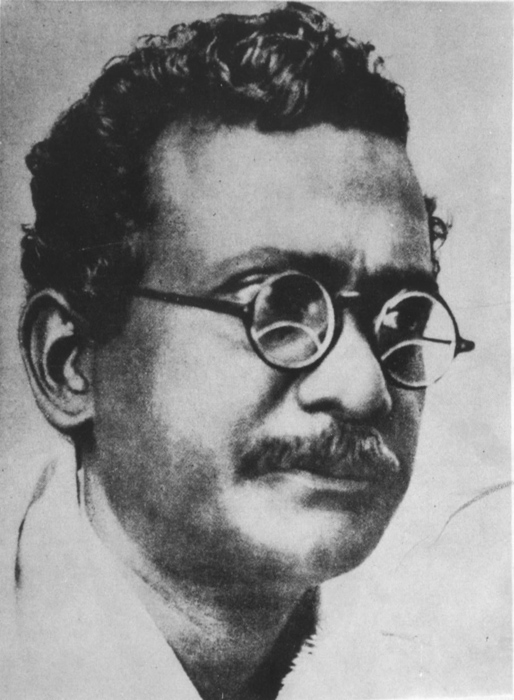
“Master-mashai, as Nandalal Bose was fondly known, remains with us as a legend. His respect for nature was as profound as his reverence for the classics. Today he comes back to us as a living presence through his great achievement in art.”
Nandalal preferred to speak with forms. He wrote letters in sketches, he greeted with pictures, he blessed with drawings. Visual form was his life-breath.
Nandlal appears like a culmination and fruition of an era. In him we witness the simplicity of an Indian peasant, the authenticity of an idealist and an enlightened patriot of the Gandhian school. His work shed the romantic verbiage and illustrative trappings of his contemporaries and developed along a definite path of formal synthesis. His swadeshi fervour did not make him illustrate the episodes of the national movement as visual reportage. He always forced the story to crystallise in a design almost like a unit form and there he expended his best talents of calligraphy and colour purely in terms of the aesthetics of vision. His swadeshi spirit was genuine, born of the soil. His respect for local material was real. Handmade paper, earth colours and handmade brushes were an outcome of his sense of sturdy self-reliance. He laughed at the consignments of British paper and colours. In truth, Nandlal, in his response to Gandhi Ji’s call, had made a serious heart-searching and had reached back to the original current of Indian tradition.
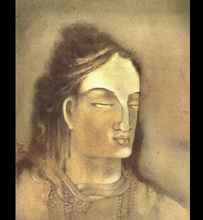
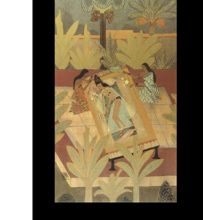
Nandlal’s early work in wash was extremely competent. It was delicate and yet sturdily constructed. He accepted the technique as was exemplified by Acharya Abanindranath Tagore. But he relied more on the structural emphasis than on the atmospheric ethereality. His line had a sinuous musculature and the colour tended towards symbolism. Visual play of light and shade did not in the least engage his interest. His study of Ajanta brought him face to face with a robust phase of realism. He at once recognised in those murals as archetype of Indian womanhood. The Ajanta woman is heavy – “like a mango tree laden with fruit.” Her skin has the glow and lustre of a Lodhra flower. Her lower lip is heavy, sensuous, like a Bimba fruit. Her glances are like “lightning”. She is, in sum, “desire” personified. Ajanta has used areas of dark colour and light colour and never attempted surface light and shade. Nandalal built his art on such sound foundations. His competence in wash painting never let him run away with the passing, evanescent effects of sunset glows or aging human beings in the dusk. The romanticism of Arabian Nights or Omar Khayyam series of Abanindranath gave Nandalal a starting point for his fresh experiments. He squarely based his efforts on the definite technique of tempera. He worked his own style enriched by his intimate experience of Ajanta, Jain, Rajput and Mughal art. His respect for his craft and profession was profound. This led him to accept the message of swadeshi in its practical aspect.
Thus we see Nandalal, a leading citizen of folk aristocracy. Khadi to him was not a mere coarse cloth made out of hand-spun yarn. To him it had infinite variations of textures born of human sensibility. Khadi was an aesthetic equivalent of our will to work and our homage to the hands. The very feel of moderately twisted yarn, woven on a simple loom, had a tactile quality. The weight, feel, colour and texture of Khadi attained infinite gradations and richness. All these qualities belonged to the parlance of art criticism. He therefore accepted Khadi on aesthetic premises. Similarly he was extremely keen in his perception of handmade utensils, handmade toys and other household objects.
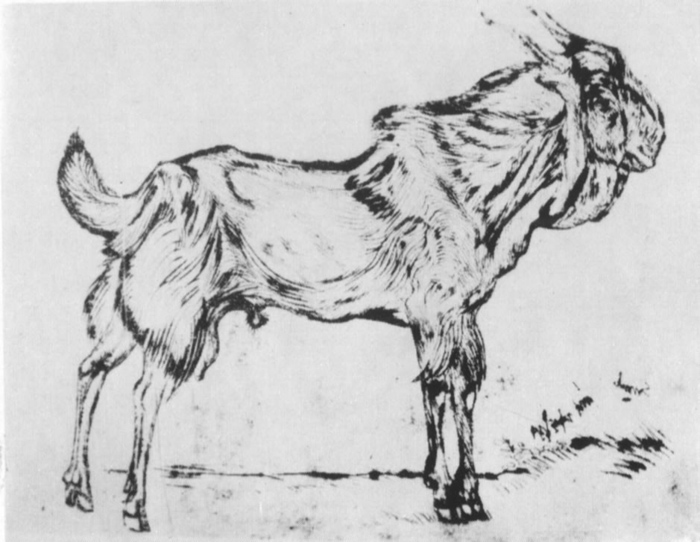
Nandalal preferred to speak with forms. He wrote letters in sketches, he greeted with pictures, he blessed with drawings. Visual form was his life-breath.
He always paid tribute to the village potter and village artisan who fashioned his wares with simple tools. His respect for the noble dignity of handmade work has a spiritual significance. Simple shapes arrived at intuitively by the master-craftsmen attracted his unerring eye. A metal-ware, a toy, or a potter’s bowl made him pause admiringly. Again, his absorbing interest in the folk arts of India was not just a matter of urban fashion with him. His folk aristocracy made him conscious of this rich treasure of the soil. He recognised that in such folk art pieces, daring calligraphy was matched by a joyous abandon to colour. Time and again he would refer to the urban greys and the fear of variegation in city life. He had observed that rural areas of India were adventurous in the use of colour on person, in textiles, in toys and in paintings. He knew that colour was an expression of our deepest springs of the unconscious. Colour was like music, born of the inmost promptings of the élan. He had noticed the jarring notes of discord imported in our cities due to a confused state of industrial revolution. Tin cans, bill boards, film posters, neon signs and the badly designed glare of advertisements had invaded the visual sanitation of our civilised life. He clearly saw that only serious art, which harnessed the vitality of folk art and rural simplicity, could stand against the general rot.
His catholicity in art permitted him to see aesthetic excellence in the Far Eastern as well as in the art of the Middle East. He was able to enjoy the subtlety of design and vitality of form in the primitive art forms of Black African and Polynesian art. He could also recognise the awesome strength of Aztec and Peruvian art. He however eschewed the optical illusionism of academic European art. On account of his initial reluctance, he kept away from European contemporary movements. He was sensitive to the strength of Matisse’s colour or Picasso’s formal distortions. His natural reflex was to recoil from their violence and lack of spiritual detachment. His refined eastern taste kept aloof from the flesh as depicted in Western art. This intrusion of matter in the realms of art was too jarring for his palette. Nandalal had his reservations about an art which was launched on its career as an imitation of visual reality. He firmly denied this. To him art was an essence, a distillation of reality. Reality as seen by the artist’s eye had to pass the fiery gates of imaginative vision. Flesh had to lose its sordid grossness and attain a state of plastic energy. He compared Rubens and Konarak to illustrate his stand. The mighty voluptuous nudes of Rubens bring to us a dynamic reality of the flesh. Young, heavy-bosomed women caught in the web of normal human passions are painted to vivify the artist’s vision. The effort is a make-believe. The perspective, light and shade, anatomy and psychology are thrown in the battle to establish suzerainty of the visual, palpable world. The Konarak erotic group stands at the other end of the pole. Here there is no make-believe. The figures locked in love-play appear as centres of energy. Limbs in their rounded affluence do not remind one of particular individual lovers. They are distillations of our total experience of union. The erotic display stands before our eyes as an empathetic transformation. Nandalal ignored the later developments of European art. The towering achievements of Matisse, Picasso, Braque, Klee, Miro, Mondrian, Brancusi and others did not find favour with him. He did not make any serious effort to change his orientation. He remained stubbornly faithful to his original classical aesthetic verities of Satyam Shivam Sundaram. His Satyam was conditioned by his faith in rural culture. He therefore retreated into his shell and disowned anything that originated in the changing milieu of an industrial machine age.
Aesthetic Nandalal stands as a counterpart of Political Gandhi. He delivered us from slavery in art expression. It is indeed an irony of fate that we are at present under the tutelage of Europe and America, because of our indiscriminate squandering of debts.
Master-mashai, now remains with us as a legend. Those who were privileged to be his students, recall his personality with affection and respect bordering on hero-worship. He was undoubtedly the gentle hero of the aesthetic land. He was a man of few words, but those few words were mined out of the rich quarries of his deeply sensitive mind. His respect for nature was as profound as his reverence for the classics. Today he comes back to us as a living presence through his great achievement in art.
Kala Bhavan has a rare collection of original sketches drawn by Nandalal Bose during his active life as an artist. Most of these were sent to his Master – Abanindranath Tagore. They are therefore doubly significant. As was his habit, Nandalal preferred to speak with forms. He wrote letters in sketches, he greeted with pictures, he blessed with drawings. Visual form was his life-breath – his innermost sensibilities quickened with any visual presence. He is most daring, original, experimental, dramatic, humorous and incisive in his sketches. Here we find his alert searching eye, capturing moving spectacle of living form. A growing tree, moving figures, frisking animals, birds on wings, rustling grass, sailing boats are firmly netted in a visual parallel. Until his death, he kept his moving hand on a constant trail of form. He sketched with a master’s hand and with a student’s eye. His mind bears witness to both – hand and eye – as the watchful Vedic bird.
About the author
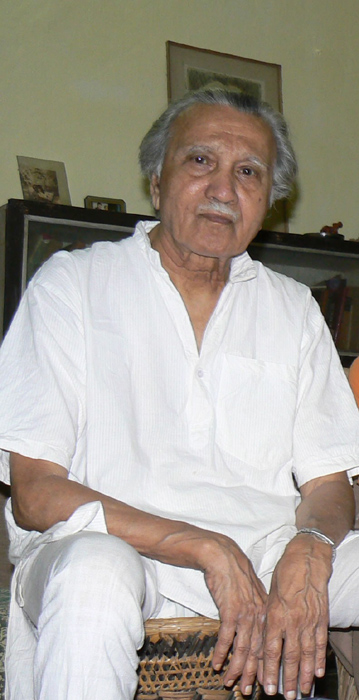
b. 1918, Dharwar, India
Education
University of Bombay, 1938
Fine Arts, Santiniketan, 1941-46
Belle Arts Roma, 1955-56
Career
Faculty Delhi Polytechnic & then College of Arts Delhi, 1949-64
Professor & Principal, College of Arts, Lucknow, 1964-67
Professor & Principal, Kala Bhavan, Santiniketan, 1967-78
Publications with translations in various languages
Age and Image (1960)
Nandalal Bose (1985)
Blossoms of Light (1986)
Akura Kakuzo (1988)
Okakura
and many other articles and booklets on Rabindranath Tagore and others.
Instrumental in the formation of the following institutions
Delhi Shilpi Chakra, Delhi
Triveni Kala Sangam, Delhi
ARTS-GLACERHI, Delhi
Delhi Polytechnic’s metamorphosis into College of Arts
Present Address
Pearson Pally, Santiniketan, West Bengal - 731235, India